Ceramic "Three Colored Double Dragon Zun" from the Tang Dynasty

Ceramic "Three Colored Double Dragon Zun" from the Tang Dynasty

This statue is a vessel used by Tang Dynasty nobles to serve alcoholic beverages. The authentic product was created during the prosperous Tang Dynasty and was unearthed from a Tang tomb in Luoyang. It has now been circulated among the people. The upper half of the statue is glazed with yellow, green, and white spots, while the lower half is plain. Pankou, neck tied, round shoulder, bulging belly, flat bottom, with symmetrical double dragon handles carved between the shoulder and the mouth, symbolizing "two dragons playing in the water". The shape is full and vivid. This exhibit is currently housed in the Luoyang Tang Sancai Ceramics Museum. First stored in the Tang Sancai Ceramics Museum in Luoyang.
Vase "Vase - Women and Fish" made by Jean Coulon

Vase "Vase - Women and Fish" made by Jean Coulon

Coarse ceramic made by Jean Coulon in 1902. 27 centimeters high; The bouquet vase with a diameter of 15.8 centimeters depicts a naiad holding a fish and opening its mouth in her arms. Yellow, brown, and green spots cover the entire area. This is a strange female figure, twisted, embracing this sea monster with an open mouth. Here, the artist created a statue without hesitation, cleverly utilizing the plasticity of coarse pottery. Collected in the Sant Museum,
The "Monchanen Vase" produced by the S è vres National Manufacturing Plant
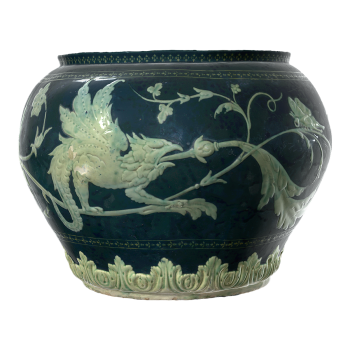
The "Monchanen Vase" produced by the S è vres National Manufacturing Plant

The size of this vase is quite slender and simple, with a blue white background and white flowers with blue stems on top. At the base, there is a blue large leaf decoration with fine lines, while the long stem rises towards the neck and blooms with small white flowers. The simplified floral decoration, while appropriately reminiscent of soapberry flowers, emphasizes the slender lines of the vase, with the bouquet blooming on the shoulders. Currently collected at the Saints City Museum.
The ceramic "Fengxiang Pink Porcelain" from the Jiaqing period of the Qing Dynasty

The ceramic "Fengxiang Pink Porcelain" from the Jiaqing period of the Qing Dynasty

This Chinese cultural relic is a porcelain vase from the Jiaqing period of the Qing Dynasty (1796-1820). The vase is made of transparent and colorless underglaze powder colored porcelain, fired in Jingdezhen, and is now collected in the Patna Museum of Art and History.
Jingdezhen Blue and White Porcelain Vase "from the Kangxi period of the Qing Dynasty

Jingdezhen Blue and White Porcelain Vase "from the Kangxi period of the Qing Dynasty

This Chinese cultural relic is a porcelain vase from the Kangxi period of the Qing Dynasty (1662-1722). The vase is made of transparent and colorless underglaze blue and white porcelain with cobalt pigment, fired in Jingdezhen, and is now collected in the Smithsonian Museum.
Modern desktop decoration dark gray ceramic flower vase

Modern desktop decoration dark gray ceramic flower vase

Modern desktop decoration gray ceramic flower vase

Modern desktop decoration gray ceramic flower vase

Modern desktop transparent glass vase

Modern desktop transparent glass vase

Porcelain "Sacrificial Blue Sky Ball Vase" from the Qianlong period of the Qing Dynasty

Porcelain "Sacrificial Blue Sky Ball Vase" from the Qianlong period of the Qing Dynasty

This vessel shape appeared during the Ming Xuande period, with a large and upright body, a majestic aura, and a sturdy and antique shape. It is named after its round and bulging belly resembling a spherical shape. The sacrificial blue glaze is often used during sacrificial ceremonies, hence it is called sacrificial blue glaze. It is also known as Jilan or Gemstone Blue.
Jingdezhen Blue and White Porcelain Vase "from the Kangxi period of the Qing Dynasty

Jingdezhen Blue and White Porcelain Vase "from the Kangxi period of the Qing Dynasty
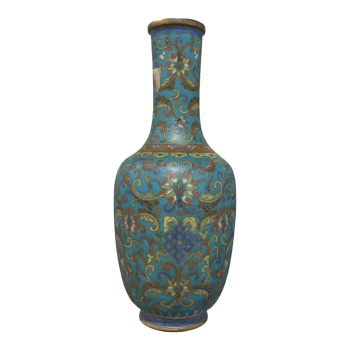
This Chinese cultural relic is a porcelain vase from the Kangxi period of the Qing Dynasty (1662-1722). The vase is made of transparent and colorless underglaze blue and white porcelain with cobalt pigment, fired in Jingdezhen, and is now collected in the Smithsonian Museum.
Porcelain from the Yongzheng period of the Qing Dynasty, titled 'Flat bottomed Oval Vase from the Yongzheng Period'
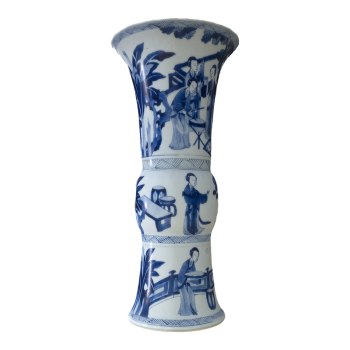
Porcelain from the Yongzheng period of the Qing Dynasty, titled 'Flat bottomed Oval Vase from the Yongzheng Period'

The vase is exquisitely painted, with a flat bottom, an oval shaped body, a cylindrical neck, and a flat, trumpet shaped mouth. The Qing Dynasty of China (1644-1912). Collected by the National Military Museum of Spain (Toledo, Spain).
Jingdezhen Blue and White Porcelain Vase "from the Kangxi period of the Qing Dynasty

Jingdezhen Blue and White Porcelain Vase "from the Kangxi period of the Qing Dynasty

This Chinese cultural relic is a porcelain vase from the Kangxi period of the Qing Dynasty (1662-1722). The vase is made of transparent and colorless underglaze blue and white porcelain with cobalt pigment, fired in Jingdezhen, and is now collected in the Smithsonian Museum.
Living room balcony home all metal red fabric wrapped flower vase decoration ornaments

Living room balcony home all metal red fabric wrapped flower vase decoration ornaments

Living room, balcony, home use, dawn color, metal lines, concave convex texture, flower arrangement, vase decoration, decorative items

Living room, balcony, home use, dawn color, metal lines, concave convex texture, flower arrangement, vase decoration, decorative items

Nordic living room desktop white ceramic hand-held vase vase vase decoration

Nordic living room desktop white ceramic hand-held vase vase vase decoration

Nordic home desktop metal frame black ceramic flower vase decoration

Nordic home desktop metal frame black ceramic flower vase decoration

The magnificent marble double ear vase in Hyde Park, Italy

The magnificent marble double ear vase in Hyde Park, Italy

The porcelain "Dionysus Ceramic Double Eared Vase" from the University Town of Paris in the 1922

The porcelain "Dionysus Ceramic Double Eared Vase" from the University Town of Paris in the 1922

Dionysus, also known as the Greek god of wine, is one of the twelve main gods of Olympus in ancient Greek mythology. Dionysus was the god of wine believed in by ancient Greeks and Thracians. Not only did he possess the intoxicating power of wine, but he also became a highly charismatic god at the time for his generosity, joy, and love. He promoted the civilization of ancient society, established laws, and maintained world peace.
Jingdezhen Ceramic Peacock Pattern Blue and White Porcelain Vase Art Decorations
Jingdezhen Ceramic Peacock Pattern Blue and White Porcelain Vase Art Decorations

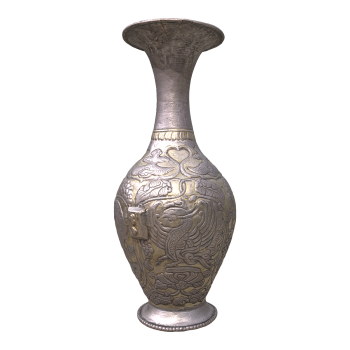
Tibetan silver vase during the Tang Dynasty "Tibetan gold-plated silver vase"

Tibetan silver vase during the Tang Dynasty "Tibetan gold-plated silver vase"

This vase is a cultural relic of the early 8th century AD from Tibet. Its name is "gold-plated silver vase". The decoration of this vase is very fine, mainly with Central Asian elements, including grape vines, bead edges and heart patterns. Sogite craftsmen are known to be adept at using gilded foil to set off silver relief designs. The form of the animal head-shaped drinking utensils and the use of silver are derived from Persian origins, while the rich, luxurious texture of the design and the form of the lion and the curly dragon on the side of the vase show an understanding of the Chinese form, which is proved in the early stage of political unity and integration in Tibet. This vase is now in the collection of the Cleveland Museum of Art.
Home Simple Red Pattern Spotted White Ceramic Vase Decorations

Home Simple Red Pattern Spotted White Ceramic Vase Decorations

Ancient Greek Antique Bronze Art Binaural Vase

Ancient Greek Antique Bronze Art Binaural Vase

Chinese classical style blue and white porcelain double ear vase

Chinese classical style blue and white porcelain double ear vase

19th Century British Antique Ceramic Vase

19th Century British Antique Ceramic Vase